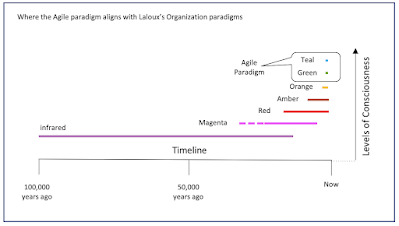
In Frederic Laloux’ book “Reinventing Organizations”, he describes organization paradigms as an evolution in human consciousness. Examining these paradigms can provide insight into organization attributes that lend themselves to an Agile culture. The early paradigm starts with the Reactive-Infrared paradigm and then Magic-Magenta paradigm. Both of these embody the early stages of humankind which include smaller groups such as tribes of people. This is followed by the Impulsive-Red paradigm which has the guiding metaphor of a wolf pack illustrated by tribal militia, mafia, and street gangs.
A blog dedicated to all things Agile with emphasis on helping you with your Agile Transformation and being Agile.
Monday, January 31, 2022
What Color is receptive to Agile?
Saturday, October 30, 2021
Hiring for the Culture of your Future
Friday, April 30, 2021
Culture of Challenging Assumptions
When you calculate the value of an idea, epic, or feature (e.g., revenue, cost of delay, etc.), many assumptions are made. As part of transforming toward an Agile culture, it is important to apply a discovery mindset that includes positively challenging assumptions so that you can better understand the value of an idea or adapt the value accordingly for the greater success of your company.
For example, a new idea is recorded that states a value of $1,000,000. The first step in challenging assumptions is using open-ended questions. Open-ended questions allow you to ask questions in a non-confrontational way. Examples of open-ended questions include: What led you to that conclusion?; What do you think the level of uncertainty is?; What is your riskiest assumption?; and What information do you need to validate this?
The second step is to validate the answers. For example, if the revenue value of an idea is $1,000,000 and based on a conversation rate of 6% but the average conversion rate for products in the field is 4%, then the calculation of value should be adjusted lower accordingly. Alternatively, if the idea uses the same potential population of potential customers as the first product that entered the field, then it is less likely that the second product entering the field will have the same potential customer size.
The third step is that you must challenges the assumptions of all ideas fairly and equally. By having reasoned conversations about those assumptions and ironing out the differences, you can get a consensus on the value so they can be fairly ranked. When the value is subjective, gut feel, those discussions can turn negative and the organization may end up putting their valuable employee effort onto lower value ideas. Inversely, the more willing and the more objectively you challenge assumptions, the more likely you will put your employee effort to good use on high-value ideas and greater success for your company
Sunday, March 28, 2021
Agile Brevity
When working within an Agile context, there is an emphasis on getting work done and meeting the outcomes of the customer needs. The work is typically structured around various Agile ceremonies depending on the methodology or process a team is using. Key to these ceremonies is to keep them concise. In order to do this, often timeboxing is introduced. However, timeboxing is only as effective as the people’s abilities to keep their discussions concise. I call this technique “agile brevity”.
What is agile brevity? It is a speaking technique that is both art and skill focused on keeping one’s comments as clear, concise, and value-added within the context of the session at hand. This means that the brain must be hyper-focused on the context and purpose of the session and speaking with agile brevity within that context. It then means that the person must consider what is the most important thing of value to say that will help progress move forward. This leads to more productive and collaborative working sessions.
Consider the Daily Stand-up. It is meant to be applied at a team level (~7 people) and take no more than 15 minutes. This means that each person has approximately 2 minutes to communicate progress and impediments. Teams new to the stand-up usually takes much longer than 15 minutes to get through their progress as they don’t yet have experience of being brief. Agile brevity means that they must consider what is the highest value information to communication the progress from yesterday, the highest value information that focuses on the work today for potential collaboration, and the specifics of any impediments so others understand it enough to potentially help, all within a very timely manner.
Agile brevity also applies to Refinement and Sprint Planning ceremonies. Within the context of these ceremonies, there is typically a timebox on how long is spent on each user story. As there is less structure in refinement or planning ceremonies than a daily stand-up, the hyper-focus of crisply asking the right questions to understand the user story is even more important. The other attribute of agile brevity is determining if your question or information is of greater value than another person’s question or information. In other words, many factors should be quickly swirling in your head before you speak.
Agile brevity is a combination of art and skill keeping one’s comments or questions as clear, concise, and value-added on the topic at hand as possible. It keeps people mentally focused, keeps working sessions tight and to the point, and ensures the highest value information and questions get discussed. While its called “agile brevity”, it isn’t specific to Agile and can be used to make any ways of working more efficient, effective, and value-added. If you find your working sessions often running long, consider trying this technique.
Sunday, February 28, 2021
Requirements Tree: Focusing your efforts on the highest value work
Sunday, January 31, 2021
Rose Retrospective - A Rose by any other Name
Many Retrospectives in the Agile world tend to follow the “what went well”, “what problems did we encounter”, followed by actions for improvement. I call this the WWW (what went well) retrospective. While this serves as a practical retrospective, did you know that there is no one specific retrospective practice expected by Agile? The Agile principle only asks that “At regular intervals, the team reflects on how to become more effective, then tunes and adjusts its behavior accordingly.” Even Scrum is not specific. Per the Scrum Guide, it suggests that a retrospective “is to plan ways to increase quality and effectiveness”.
If you are applying the “what went well” type of retrospective, would you like to experience something new, a more adventurous retrospective? Allow me to introduce you to “A Rose by any other Name” Retrospective or Rose Retrospective.
This is a botanical approach that uses the parts of the rose to explore how things are going and what you can do to improve. The parts of the rose that we explore during this retrospective are the Flower, the, Thorn, and Bud. To put some color to these parts, here are some definitions:
- Flower: This highlights the positives, what you're happy about or what is going well for you or the team.
- Thorn: These are negative things that are impacting your work or life. It may be something that didn’t go your way, causing stress, impediments to success, or something that you’re not proud of.
- Bud: These are areas that have a potential to bloom or improve if we nurture and put some focus onto them. They have the potential of becoming a flower.
How might you implement a Rose Retrospective? Let’s step through the preparation and steps through conducting a retrospective.
Prepare the space
Whether a physical room or a virtual room, create a space to (e.g., white boards, etc.) to add Flower, Thorn, and Bud.Determine what cohort of people will participate. It is best to invite those that were actually engaged in the topic (e.g., the team that did the work).
Conduct the session
Start by explaining the process of the Rose Retrospective and the meaning of the flower, thorn, and bud. Advise them on what they will be reflecting on (the recent sprint, project, time period, etc.).Begin with Flowers. Give everyone 5 minutes to brainstorm their flower(s). Everyone shares their flowers. This may include recent successes in delivery, relationships, and progress. You may use data as an input. The intent is boost morale and make people feel proud of their activities and progress. The result is to visualize as a bouquet of flowers on a rose bush.
Continue with Thorns. Give everyone 5 minutes to brainstorm their thorn(s). Everyone shares their thorns with the intent is to share challenges. The result is to visualize the thorns of a rose bush.
Finally, the group discusses the buds. Reviewing the Thorns, consider what can be improved and actions for improvement. Provide time to consider the root cause, brainstorm new ideas, and suggesting solutions. Also consider other ideas that may need a boost in areas that are ripe with infusing extra effort to turn the bud into a flower. Prioritize ideas and solutions and focus on the top 2 or 3 actions. The result is to visualize a group of buds that may blossom with some extra effort.
Work on the actions
Once the session is over, the next steps are to add the actions to your backlog of work, marking them as high priority. Then work on the actions to turn the buds into bouquets of flower.
Sunday, October 25, 2020
Are You Experiencing Modern-day Acedia?
As the pandemic continues, is the social isolation and restrictions in movement causing a feeling of melancholy and unmotivated? Are you losing interest in posting selfies, attending web conferencing events, and streaming shows and movies? As the news gets worse, do you find yourself devouring negative news and getting sidetracked by social media, yet have a number of home projects to do?
“You're bored, listless, unmotivated, afraid, and uncertain. What you have may be feeling is 'acedia'. This occurs when you have spatial and social constrictions that a solitary life necessitates. Acedia is combination of listlessness, undirected anxiety, and inability to concentrate.” Having similar attributes to seasonal affective disorder, Covid is lasting much longer so it provides a greater sense of undirected anxiety as there doesn't seem to be an end in sight.
With the next wave of Covid occurring, if this feels like something you are experiencing, it could be acedia. The novelty of adapting to the first wave with restricted lifestyle was fun or at least interesting in the initial wave as we adapted to this new way of living. However, in this second wave, it is no longer novel and may be a bit vexing as we stare at our screens in dreariness. Those things that we did to pass time are no longer amusing or even interesting. Are you starting to have the feeling of acedia?
As leaders, it can happen to us and it can happen to our employees. What can we do? The first thing is call it by its name. Having a name to what you may be feeling connects it to something real. Once it is recognized as something real, you can more easily do something about this. What you may have is “acedia”. How that we recognize it by its name and that it is a real thing, we can try to put actions in place to minimize it. Here are some things we can do for ourselves.
Establish a routine. It’s not uncommon in this pandemic that we have let our schedules slide a bit. However, while this may be good for vacations, it has been proven that having a routine can be helpful in times of uncertainty. Providing a routine to our day can give us a sense of control, reduce stress levels, and improve our focus and productivity.
Find a new non-screen interest such as a hobby, sport, or outdoor activity. The advantage of this is these types of activities are absorbing and encourages you to take some time for yourself. Focusing in on an interest can relieve stress by keeping us engaged in something we enjoy.
Initiate an exercise regimen. As the pandemic can make it challenging to participate in a health club, setting up a home regimen with minimal equipment can be beneficial. This can include a walking, jogging, or cycling regimen. The benefits of regular exercise are that it can improve our mental health and mood, and boosts your energy level.
Finally, allow time to celebrate. This includes personal events like birthdays, anniversaries, graduations and work-related events like releases into production, retrospectives, work anniversaries, and other employee’s personal events. The act of celebrating can relieve stress. Remember, acedia is often a result of being drawn to negative news. Taking the time to celebrate breaks the negative cycle and changes the focus to something more positive.
If you are feeling bored, listless, unmotivated, afraid and uncertain, what you might be experiencing is acedia. If you think you are, put a name to it so you recognize it as some real. More importantly, put actions in place to mitigate the effects. This may include establishing a routine, finding a new non-screen interest, initiating a new exercise regimen, and allowing time to celebrate.